If artificial intelligence can answer customer questions, analyse data, draft content, write code and run workflows, one question quickly becomes unavoidable: what should organisations still keep human? As AI moves from isolated experiments into everyday operations, the challenge is no longer just finding tasks to automate, but deciding where judgement, responsibility and trust still need a person in the loop.
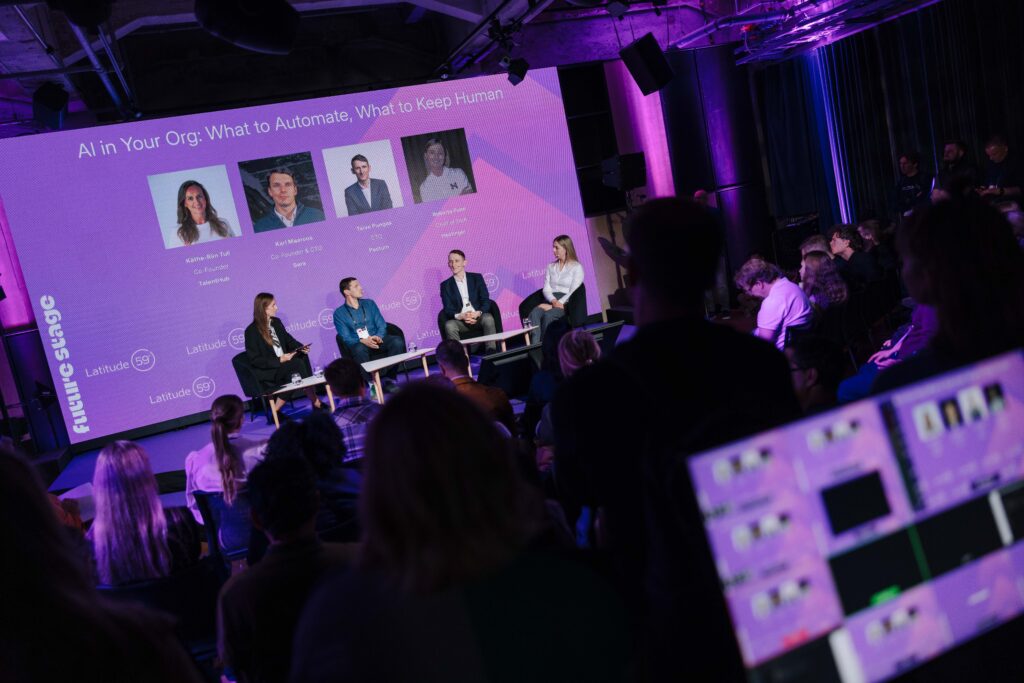
At Latitude59, Käthe-Riin Tull, co-founder of TalentHub, moderated a discussion on how companies are putting AI to work in practice, and where human judgement still matters. She was joined by Karl Maaroos, co-founder and CTO of Sera; Taivo Pungas, CTO at Pactum; and Roberta Pukė, member of the executive team at Hostinger, where she leads company-wide, process-driven operations.
AI is no longer a side experiment
The conversation opened with a question that many organisations are currently asking themselves: how much of the work is already AI-assisted or automated? While none of the speakers put an exact percentage on it, the answer was clear: AI is no longer a side experiment. In their companies, it is already touching nearly every team in some way.
Roberta Pukė explained that at Hostinger, every employee is expected to think about how AI and automation could support their work. The company has built internal tools and an agentic platform that employees can use safely, but the aim is not to slow people down with too much central control. For a fast-moving company, the challenge is to give teams freedom to experiment while still keeping enough visibility over what is being built and used.
Taivo Pungas highlighted a similar balance at Pactum: When a tool is useful and people adopt it organically, don’t ban it. Understand why it works and how to use it responsibly. At the same time, he noted that AI can create hidden risks when different people use it to interpret the same information and end up with different narratives. In that sense, the risk is not only that AI gives a wrong answer, but also that a shared understanding inside the organisation slowly becomes fragmented.
Automation is changing what you hire for, not just how many you hire
Karl Maaroos made a point that’s easy to miss in the “AI will replace jobs” debate. In a small company, AI mainly affects how much the team needs to grow, not whether current roles disappear. If people can do more with the same team, the question shifts from replacing roles to hiring differently.
Routine, clearly described tasks are becoming less valuable as standalone work. Routine, clearly described tasks are becoming less valuable as standalone work, while the ability to understand context, shape processes and use AI well is becoming more important.
Hostinger’s example showed the same shift at a larger scale. Pukė said that AI now handles a large share of customer support tickets, allowing the company to serve a rapidly growing customer base without growing the team at the same pace. This does not mean cutting people, but changing what people focus on: more complex cases, better judgement and higher-value problem-solving.
Responsibility doesn’t transfer to the tool
A recurring theme throughout the discussion was responsibility. The speakers warned against treating AI outputs as finished work. Maaroos stressed that employees remain accountable for what they produce, regardless of which tools they use. AI can help with research, analysis and drafting, but it does not remove the need to understand the task, check the result and make sure the output is actually useful.
The speakers agreed that not everything should be automated. A good warning sign that something has gone wrong: when maintaining an automation takes longer than doing the task itself. In those cases, it may be time to rethink the workflow rather than keep forcing the tool to work.
What stays human
The panel ended with a simple but important conclusion: automate what can be automated, but keep decision-making, verification, critical thinking and emotional trust human. AI is powerful for processes, speed and scale. But organisations still need people to decide what matters, judge whether outputs can be trusted, and build the kind of relationships that don’t reduce to a workflow. Understand why it works and how to use it responsibly.