PRESS RELEASE
TALLINN, ESTONIA – European LP and GP investors who gathered in Tallinn, Estonia, highlighted the Nordic region as an excellent growth environment for new technologies and companies. They also noted that Europe as a whole has developed a strong pipeline of companies with the potential to scale globally. At the same time, investors pointed out that access to capital for innovation in Europe remains challenging, and that the local technology sector continues to rely heavily on US capital.
Madis Lehtmets, Managing Director of the Estonian Private Equity and Venture Capital Association (EstVCA), explained that the LP–GP Meetup in Tallinn brought together investors representing international capital, alongside leaders of private equity and venture capital funds from the Nordic region and other parts of Europe.
“Our aim was to create a high-quality, targeted platform for meaningful discussions. The idea grew out of the need to better understand and address the needs of the Nordic-Baltic private equity and venture capital market. Public funding works well in Europe today, but attracting private capital investors is crucial for the growth of funds operating in our region. We therefore need to think about how to increase European capital’s willingness to invest in funds based here,” Lehtmets said.
The LP–GP Meetup opened with a conversation between entrepreneur Taavet Hinrikus, founder of the venture capital fund Plural, and Margus Uudam, founder of the venture capital fund Karma Ventures.
Taavet Hinrikus pointed out that Estonia has shown how a small country can be a good place for new technologies and companies to grow. “When we were building Wise, nobody wanted to invest in regulated industries because they were considered too complicated. Now nobody is afraid of that anymore,” he said.
Hinrikus and Uudam agreed that Europe currently has a strong pipeline of companies with the potential to scale significantly, but that securing funding from outside the United States remains difficult. The strongest growth potential today lies in deep tech, hardware, robotics, the defence industry and other technically complex sectors.
Madis Lehtmets, Managing Director of the Estonian Private Equity and Venture Capital Association (EstVCA), explained that the LP–GP Meetup in Tallinn brought together investors representing international capital, alongside leaders of private equity and venture capital funds from the Nordic region and other parts of Europe.
“Our aim was to create a high-quality, targeted platform for meaningful discussions. The idea grew out of the need to better understand and address the needs of the Nordic-Baltic private equity and venture capital market. Public funding works well in Europe today, but attracting private capital investors is crucial for the growth of funds operating in our region. We therefore need to think about how to increase European capital’s willingness to invest in funds based here,” Lehtmets said.
The LP–GP Meetup opened with a conversation between entrepreneur Taavet Hinrikus, founder of the venture capital fund Plural, and Margus Uudam, founder of the venture capital fund Karma Ventures.
Taavet Hinrikus pointed out that Estonia has shown how a small country can be a good place for new technologies and companies to grow. “When we were building Wise, nobody wanted to invest in regulated industries because they were considered too complicated. Now nobody is afraid of that anymore,” he said.
Hinrikus and Uudam agreed that Europe currently has a strong pipeline of companies with the potential to scale significantly, but that securing funding from outside the United States remains difficult. The strongest growth potential today lies in deep tech, hardware, robotics, the defence industry and other technically complex sectors.
“We are making an extra effort to find more non-US investors, but it is difficult to find European investors, and they take much longer to convince. I also spent some time in Japan, but it feels like you have to go there three years in a row just to build relationships before anyone will take you seriously,” Hinrikus said, adding that this helps explain why companies still largely rely on US capital.
According to Hinrikus, European startups are held back by attitudes towards risk-taking and a fear of failure. “If you fail in Europe, everyone writes you off and nobody wants to work with you again, which is the opposite of the US,” he said. In Hinrikus’s view, the same logic also applies to institutions, where the potential upside for decision-makers is often very limited, while the negative consequences of making the wrong choice can be significant. “I do think we need more government help to allocate more capital to the European innovation sector, because the continent needs us,” Hinrikus said.
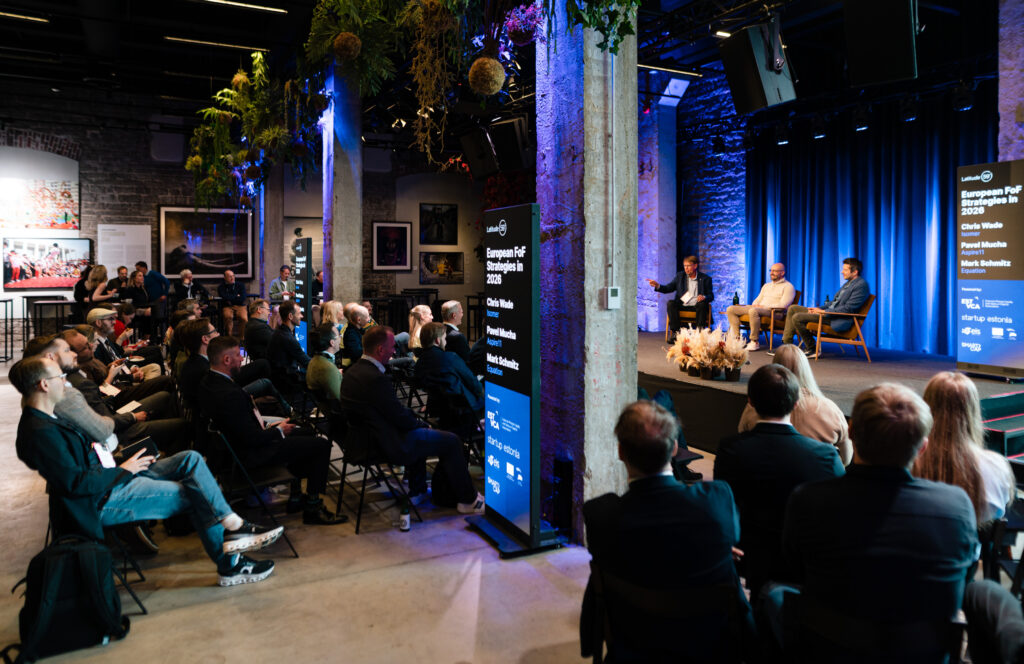
Chris Wade, Managing Partner at Isomer Capital, one of Europe’s most active fund-of-funds managers, joined Mark Schmitz and Pavel Mucha on stage to discuss European fund-of-funds strategies. The conversation focused on developments in the world of LPs and on the geographies and sectors currently attracting investment.
Speaking about investment trends, Mark Schmitz, founder of the Germany-based fund of funds Equation, explained that the strongest potential is currently seen in deep tech, including biotechnology and space technologies. At the same time, he noted that Equation reviews its sector focus every five years, assessing which sectors could offer strong exit opportunities ten years down the line.
“When we see a manager in Europe who meets the very high bar and rare potential we would expect from the US, the most competitive market in the world, we will definitely come on board. If we cannot find that, then we will allocate some money in the US,” he explained. Schmitz added that although China’s innovation ecosystem is currently one of the leading ecosystems in the world, they are not ready to invest there at present.
Pavel Mucha, founder of Aspire11, a €500 million global fund backed by pension capital, noted during the discussion that investments are currently being made both in next-generation high-growth companies and in early-stage venture capital funds. At the same time, he emphasised that attracting pension capital requires fund managers to strike a careful balance between risk, return and liquidity.
“If we want to bring pension capital into venture capital, we need to balance risk, reward, and liquidity for them,” Mucha said, adding that venture capital must fit with the responsibilities and time horizon of pension funds.
Chris Wade concluded the discussion with an optimistic message about the future of European venture capital.
“European venture capital is going to become one of the most important venture capital ecosystems in the world. I have no doubt about that,” Wade said. In his view, Europe will produce a trillion-dollar company within the next five years. Wade recalled that when Isomer started, Europe had around 20 unicorns, and that the forecast made at the time, that the number would reach 400 within ten years, has almost come true. “The only reason the US has achieved its current performance is that it has been doing this for twice as long. If you go back to 30 years into the US venture-capital system, Europe is ahead of where the US was at that point,” he said.
The meeting of Nordic and European investors and venture capital fund leaders took place in Tallinn as part of the technology conference Latitude59. The LP–GP Meetup brought together international investors including Mubadala, Cambridge University Endowment Fund, Itochu Corporation, Isomer Capital, Equation Capital, Plural VC, Fåntell, Skaala, Aspire11, 2C Ventures, Karma Ventures, Siena Secondary Fund, Mojo Capital, eQ, Genesis Investment Partners, the University of Jyväskylä investment fund and SmartCap.
The meeting was organised by the Estonian Private Equity and Venture Capital Association, with support from Startup Estonia and SmartCap.